It was a snowy start to 2026 and as is normally the case the snow didn't reach the Peterborough area. We made two trips in to Norfolk in a three day period in the hope of seeing a few Norfolk churches in the snow, but trying to do this safely; with memories from just before covid hit of a trip in to Derbyshire and getting caught in a blizzard in the Dales and being fortunate to get home on the day.
The first trip out was on the Saturday. The east coast was on a severe weather warning for snow and we heading out in to it. It was bitterly cold with a real bite to the wind bit it wasn't the most successful of trips out with just a scattering of snow around the Fakenham area. There was a fairly substantial fall of snow in the Swaffham area on the Sunday night and we popped back on the Monday to take a look.
This page will take a look at the churches at Swaffham and Necton with exterior shots from this January 2026 trip out, with interior shots, with the exception of the angel roof at Necton being taken on a previous visit.
SWAFFHAM : THE CHURCH OF ST PETER & ST PAUL
Church Post Code PE37 7AB
Open to visitors
Visited January 2026


Swaffham is an attractive, bustling, market town of getting on for 8500 people according to the 2021 census. It can be found 12 miles east of Kings Lynn and 31 miles west of Norwich. The church of St Peter and St Paul is centrally located, with the main roads through the town running close by. The church was open when I visited on a Saturday morning and a coffee morning was in full swing. Lots of people were there and there was a lovely buzz about the place. After the difficult choice between cheese scones or lemon drizzle cake was made I got to work and started to tour the building.
The current church here was built between 1454 and 1465, with the tower coming a little later, from 1507 until 1510. It was built over the site of an existing church which had partly collapsed. It is not known when that original church was founded but there was no mention of a rector here until the 12th century. It is suspected though, that the history of the church here could date back far earlier than that.
The church is made from Barnack stone and is based on a cruciform plan with west tower, nave, chancel, north and south aisles and north and south transepts. The tower is two stage and is buttressed, with crocketed pinnacles at each corner. gargoyles surround the tower and a grotesque, badly weathered, sticks its tongue out in medieval gesture of insult. A winged mythical beast sits at the centre of the southern edge of the tower and a similar creature sits on a plinth at the end of the nave roof, looking out towards the east. Elsewhere, a muzzled bear like creature looks upwards towards heaven. There are shields at the base of the tower featuring crossed keys, a symbol for St Peter, and crossed swords, a symbol for St Paul.


The tower once had a turret but this was replaced in 1778 after the turret was struck by lightning. This was a timber and lead spire, which in turn was replaced by the present structure in 1897. A close look up high shows that this again has the keys and swords symbolism.
Eight bells hang here, with three of these being cast in 1737 by Thomas Newman of Norwich. Four were cast by Miles Graye I who worked from premises in Colchester, in 1631 with the same founder adding another bell three years later. Church bells would have dated back for many years before that, with details lost over the years, however, record was made of Alice, wife of Hugh Mustarder, providing funds for 'a lytle belle' as far back as 1420.


Moving inside, the nave is bright and welcoming. Walls are whitewashed and the seven bay arcades are tall and elegant, resting on circular bases with circular capitals. The hammerbeam roof in the nave dates from the early 16th century and is spectacular. Carved angels, made from chestnut wood, can be seen at the end of the beams. There are 88 in total with the angels holding shields which show the instruments of Christ's Passion. Just over 100 further angels are carved in to the wall plate to north and south. When Victorian restoration work was undertaken on the roof in the late 1880's, musket shot was found embedded in to some of the angels. A magnifying mirror is set in to a wooden case in the nave to help the visitor see the angels better.
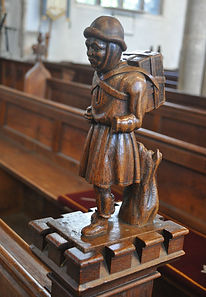
At the eastern end of the nave are pew carvings of a peddler and a dog. The peddler is walking and carrying a backpack. The dog looks upwards towards heaven. This pays homage to a local legend concerning a pedlar called John Chapman who lived in Swaffham. He had a dream that if he went to London Bridge he would hear good news. Only when the dream was repeated the next night did he act on it, and packing his bag, he and his dog walked to London.
He found his way to London Bridge early one morning and stood there waiting for the news. Eventually a shopkeeper who had been watching him just standing there came over to ask him what he was doing.
The pedlar told him of his dream, and the shopkeeper laughed, saying that if he had believed in dreams he would be in a place called Swaffham, where ever that was, digging up gold under the apple tree of a man called Chapman, but that he didn't believe in dreams and that the pedlar should go back home and carry on with his life. The pedlar thanked the man for his advice, and made his way back home. On reaching home, he dug under his apple tree and found a small pot filled with gold coins. He put the coins away and cleaned the pot, finding a strange inscription. As he couldn't understand the inscription he put the pot on his stall and life carried on. A few weeks later a wandering monk passed the stall and spotted the inscription on the pot. He asked the pedlar if he knew what it said, and when the pedlar said no, the monk translated it for him...'Under me doth lie, another richer far than I'
When the monk had gone, the pedlar quickly dug under the apple tree again, much deeper this time, and eventually found a much larger pot again filled with gold. Soon after, the inhabitants of Swaffham decided to rebuild the church, and were very surprised to find the pedlar offering to pay for the north aisle and the tower



The chancel was restored during Victorian times. The centrepiece of the fine east window, which is dated to 1853 and made by William Wailes, is the risen Christ, standing on His tomb, wounds visible, with an angel standing at his side, finger pointing to heaven. Two angels pray over him. St Peter and St Paul stand to either side, with each identifiable by their associated symbols as well as their lack of hair! Peter holds the keys to the Kingdom of Heaven. St Paul holds his Gospel along with a sword. Normally this is shown pointing downwards but this time it is help point up. Also present are the four Gospel writers.
A roundel at the top of this window shows Christ in majesty, sitting on the clouds, hand raised in blessing and holding a globe, surrounded by the symbols of the four Gospel writers and flanked by angels playing harps.
The triple sedilia and the double piscina, in their traditional places against the south wall of the chancel are each medieval survivals.
A monument to Katherine Stweard is dated to 1590; she being Oliver Cromwell’s grandmother. She kneels; wearing Elizabethan ruff, holding a prayer book on which is a human skull. Her other hand presses down on the skull; downward pressure on the skull symbolising that death, in the form of the skull, has been beaten, a testament as to the faith of the deceased.


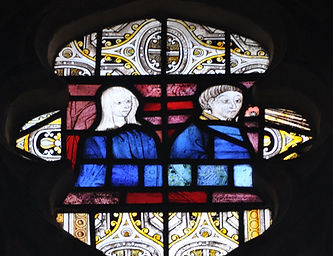
There are some fragments of medieval glass high up in the windows of the north aisle. Some interesting fragments with a male and female at prayer, with a bearded face, missing the top part of his head, above. Two beautiful angelic heads, with nimbus and with just a glimpse of golden wings, are below a torso, on its side, which is holding a sword. Close by, a female figure wears a long flowing headdress with a male figure at the side sports a hairstyle which I thinks dates from the 15th century. Reminded me of the first series of Blackadder and apparently, according to a website I found on medieval hairstyles, it was cut this way to allow the helmet to easily be put on when wearing armour.
Other glass in the church is Victorian and is of fine quality. One window caught my eye, and this depicts the three recorded instances when Jesus raised the dead. The left hand panel shows the raising of the son of the widow of Nail, central is the raising of Jairus’ daughter and on the right we see Lazarus emerging from the tomb, peering out through his shroud; hands raised in prayer with sisters Mary and Martha looking on.
Other carved bench end includes a sleepy lion, a woman with rosary beads, a muzzled and chained dog and the pelican in its piety. The latter is a bird plucking at its chest and feeding the blood to its young. This was often used as an analogy to the Christian faith with Jesus shedding his blood for his children.



This is a fine church; and it was good to see it with a covering of snow in the church grounds set against an almost cloudless winter sky. Always open and welcoming, I have fond memories of my times here including some very fine lemon drizzle on a Saturday coffee morning as I made my way towards Norwich on the first day of a Norfolk churchcrawl back in 2012. There was time for a quick tour around the charity shops in the town; then collecting lunch from a very fine bakery close to the church before we headed off a couple of miles east to neighbouring Necton .
NECTON : CHURCH OF ALL SAINTS
Church Post Code PE37 8EH
Open to visitors
Having left Swaffham we made our way to Necton. I wanted to revisit here for two reasons; firstly I wanted to photograph the church in the snow and secondly was the medieval angel roof here. I wanted to reshoot this roof with my new mobile phone. My old and trusted Nikon zoon had broken earlier in the year and I couldn’t afford a replacement, It appeared as if the zoom on my new mobile was better than this old and loved zoom. This was an ideal chance to test it out!
Necton can be found at the side of the A47, in between these two villages, but closer to Swaffham. A familiar landmark at the side of this busy road. Necton was mentioned at the time of the Domesday Survey in 1086 and at the time of the 2011 census, the population was just under 2,000.
There was a church here at the time of the Domesday Survey, but only the north wall of the chancel survives from this early structure. Much of the present structure dates from the 14th and 15th centuries, with much work undertaken here during the 19th century. In 1326, Lady Maud De Tony of Coxford Priory Manor paid for the building of the chapel of St Catherine, much of the present structure being built in the years following this.


The west tower here has an interesting history. The majority of the tower was re-built during 1864 and 1865 after the previous tower cracked under the weight of the peal of six bells. The tower that we see today is of three stages, buttressed to three quarters of the way up, and with a clock situated on the west face of the tower, this clock dating from before the tower was re-built. The tower is battlemented with a crocketed pinnacle at each of the four corners. On the top is an octagonal lantern with lead finial.
The ring of six bells here, which may allegedly have been responsible for damaging the tower were cast by Thomas Mears II of Whitechapel in 1833. L'estrange, in his Victorian study of the church bells of Norfolk, has little to say about this ring of six, which could well have been re-castings of bells that hung here previously, but he does state that one bell is inscribed ' This peal of six bells was hung in June 1833 in the reign of His Majesty Wm 4th...'.
The church looked beautiful with a covering of snow in the grounds and hardly a cloud in the sky. Approaching the church from the south I saw a tomb on which there was a figure at prayer. I had seen this on a previous visit; here though it was covered in snow with the recumbent figure delicately covered in snow so that the features were still discernible. Delicate and beautiful!
A ferocious grotesque shows an impressive set of teeth as I walked below it. The bench positioned looking away from the church to the south might have been appetising on another day.


The church was open to visitors and inside it was bright and welcoming with some friendly locals working in the church. It was the day after epiphany; the wise men had arrived, that was Christmas done for another year with the decorations being packed up. Exterior shots used on this page, as well as the photographs of the angel roof are from this January 2026 revisit with other interior photographs used coming from a previous visit back in 2016.
The nave was re-modelled in 1490 and the height of the nave was raised by 14 feet, allowing for the addition of a clerestory, eight windows to both north and south. The south clerestory windows were certainly doing their job on this bright and crisp morning.
There are four bays to north and south and there is a gallery in front of the tower arch at the west end. Stone heads in the nave include a green man and a human figure with sightless eyes, who appears to be wearing a collar of some sorts. Damage to this figures nose possibly suggests that the iconoclasts of the reformation took exception to this one.
The pulpit dates from 1636 and the communion table from two years earlier. The fine east window in the chancel depicts three angels at prayer and was made by De La Roche of Paris in 1844.
In front of the east window is a reredos which illustrates the raising of Lazarus. In a very crowded scene, Jesus points at Lazarus, who is struggling to cast off his grave clothes. Boards noting the Ten Commandments are to either side of the central painting.


Angels line the nave to north and south, fabulously carved and still retaining some of their original colouring. Some are at prayer, another wields a censer whilst another holds out a chalice. Wings are multi coloured and the boards of the roof are also painted and patterned. Several tiers of smaller carved angels, many carrying a shield, run along both walls of the nave. This must have been a truly wonderful sight when it was completed back in the late 15th century. One or two of the angel carvings were highlighted by shafts of sunlight. A recess over the chancel arch would once have held a statue, I daresay of Christ, which would have acted as the focal point for the whole display. Wonderful and inspiring!


Elsewhere, a floor plaque features a human skull, reminding the onlooker that Man is mortal and will die. Up on a wall plaque a cherub is depicted in an attitude of mourning, head in hand whilst holding the flame of life to the ground. If the flame of life is life is downturned it symbolises death and mourning, if the flame is held upright it symbolises eternal life.


The church grounds are spacious and well maintained. To the south there is an interesting carved slab, mentioned earlier, which was covered in snow, which is placed on top of a chest tomb. This features the recumbent effigy of a woman in long flowing dress, wearing a veil and with hands raised in prayer. This dates from the 14th century and has a Grade II listing in its own right. It is suggested that this is the grave for the Countess Of Warwick who fell ill and died at Necton, whilst on a pilgrimage to Walsingham.
There are some finely carved gravestones here dating back to the eighteenth century, with several of these containing a depiction of the trumpet, used often as a symbol of the resurrection and the crown, used as a symbol of victory, with the victory in this case being over death. Both symbols express the Christian faith of the deceased.
This is an attractive and well loved church; which was photographed on the most glorious of days. I was pleased with the re shot photographs of the angels in the roof; my new mobile was certainly performing better than my old zoon had. On one hand this made me very happy; but the luddite in me was having other thoughts; having difficulty in accepting that a little mobile could out perform my old and trusted zoom. A small part of me felt betrayed!
The plan was to head back towards Kings Lynn via Sporle and East Winch, each of which were closed before crossing in to Lincolnshire and taking a long and circuitous route home. The snow brings out the child in me; it was great to have been out in it.