OVER : CHURCH OF ST MARY

Church Post Code CB24 5NH
Open to visitors
Visited June 2024
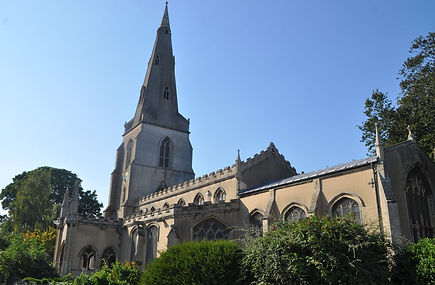
I visited the church of St Mary at Over Cambridgeshire twice in fairly quick succession during 2024. The first visit was late on in the afternoon during March; the light was starting to fade and the quality of the interior shots suffered as a result. I popped back in June, on a gloriously sunny day to reshoot. The church was open to visitors on each occasion; with the church here becoming a personal favourite.
Over is a fairly large Cambridgeshire village which recorded a population of 2,895 at the time of the 2021 census. Huntingdon and St Ives can be found off to the west; the former some ten miles away with St Ives closer. Cambridge is roughly the same distance off to the south east. The cathedral city of Ely is 17 miles off to the North West by road, but considerably less as the crow flies across the flat Cambridgeshire Fens; the River Great Ouse runs close by to the west of the parish.
There was no church of priest mentioned here at the time of the Domesday Survey in 1086; with the village at that time held by three land owners, which included the Abbeys at Chatteris and Ramsey. The village that we see today used to be two settlements, with one located around the site of the present church which can be found to the extreme north west of the village, with the other at the south east; the two running in to each making for the present village.
The church of St Mary stands alongside the main road which connects it to neighbouring Swavesey off to the south west. Despite the main road this was a quiet, pleasant location with the church shielded from its neighbours on three sides by trees.


The church that we see today consists of west tower with spire, nave with north and south aisles and clerestories, south porch and chancel. The church of St Mary dates back to the 13th century but the present building dates mainly to the early 14th century, with additions during the 15th century and a full restoration in 1840. At first glance, this is an impressive structure, reflecting the status of this building back in the day.
Looking at the church from the south, the three stage west tower dates from the early 14th century period of rebuilding and has a staircase to the south east corner, with church clock facing out from the south. The west door of the tower has a carving of the Virgin Mary within an aureole which is flanked by empty image niches. It is interesting that the statues on either side of the statue were taken down and in all probability destroyed but the image of the Virgin Mary was left untouched by the iconoclasts. Perhaps there is an insight in to the minds of the reformers here; with a destruction of an image of Mary herself being a step too far for them!
An impressive octagonal broach spire rises up; and raises up to an impressive 156 feet making it one of the highest in Cambridgeshire. The spire has three tiers of gabled lucarne windows; the tip of the spire appears to have been replaced or worked on at some point in the recent past. The outline of the pre clerestory roofline can be seen clearly against the east wall of the tower.
The south porch dates from the first quarter of the 14th century, and is very large and ornate, with space for a room above but seemingly not having one. A frieze of ballflower design runs across the top with a bearded head looking out sternly from the apex. The porch is battlemented and the entrance is flanked by two octagonal spires, with animal heads peering out from amid the ballflowers; which include a lamb and a dog.


The clerestory is of six two light windows; the nave and clerestory are battlemented and what remains of a bellcote from which the Sanctus bell would have hung can be seen at the east end of the nave. The ballflower frieze runs the length of the nave. Gargoyles of great imagination and quality look out from the south wall of the nave. These include a human male in torment, a shackled lion, a water carrier, a human male figure wearing a powdered wig which pulls open its mouth and a wonderful depiction of an owl; with one ear missing and wings small enough to cast doubt on their ability to support it in flight.
When JJ Raven had his book on the church bells in Cambridgeshire published in 1869 he didn’t look at the church in any great depth; just recording that there was ‘a peal from the St Neots foundry before 1825’. There was a ring of six here at the time of Raven’s study, cast by Robert Taylor in 1819. I have not been able to find any note of inscriptions. Today there is a ring of eight with two further bells added by Mears and Stainbank of Whitechapel in 1931.


The visitor enters in through the south porch. It was good to see the ‘Church Open’ sign out. Moving inside it was bright and welcoming; walls are whitewashed and there was plenty of sunlight streaming in through the clear glass to the south. The north and south aisles here were each part of the rebuilding programme of the first quarter of the 14th century. The arcades themselves though were rebuilt and date from the 15th century. There are six bay arcades to north and south with quatrefoil piers and capitals which have carvings of human heads peering out in places. An medieval oak rood screen screen separates nave from chancel; the church organ is against the north wall of the north aisle. There is stained glass at the east ends of north and south aisles; which we will look at in detail in a while. Fixtures and fittings seem to date from the early Victorian restoration; red carpet runs up the nave at up to the high altar.


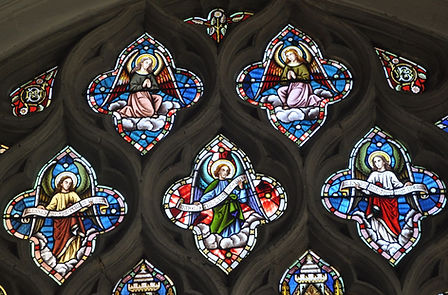
Moving in to the chancel, this was much altered during the restoration of 1840; but the medieval piscina, in which the holy vessels used during the Mass were washed, to the south wall of the chancel and the aumbry, in which the holy vessels were stored, are both still in place. The high alter is plain and simple with just a single rustic cross; the reredos takes the form of a red curtain, symbolic of the blood shed for us with across the top a series of angels at prayer; wings unfurled with script reading ‘Holy Holy Holy Lord God Of Hosts’ running below the angels.
The east window is of four lights and has stained glass panels on two levels, with a little more in the tracery. To be fair, this isn’t my favourite glass and on both visits it was fairly dark and uninspiring. On the upper level we see the Ascension with Christ rising in front of the 11 remaining disciples. The risen Christ, who is flanked by angels, holds out his hands, wounds visible, with a pulsating golden aureole around his head. Various parts of the design are gilded, but the background and the disciples’ cloaks are all dark. Perhaps this was deliberate to make certain things stand out. If so, then it doesn’t work for me; perhaps it looked beautiful earlier in the day when the sun was shining in from a more easterly direction.
On the lower level we have single light depictions of the annunciation, the nativity with just Mary, Joseph and the Baby Jesus, the crucifixion, another nativity with the wise men having arrived and Jesus being presented to Simeon in the Temple. Anna looks on whilst Joseph holds two doves; this being the sacrifice required for those of limited means who couldn’t afford a lamb.


The window of the east end of the south aisle is beautiful and very interesting; with two panels depicting Bible passages that I can’t recall having seen in glass before. This is of four lights and reading from left to right we start off with the reinstatement of Peter; with the risen Christ instructing Peter to ‘Feed My Sheep’ and lead the church this after Peter denied knowing Jesus three times on the night of his arrest.
Then things get interesting, and to be fair a little obscure! We see two women talking to a man with the text below reading ‘If ye have judged me to be faithful to the Lord’. This comes from Acts Chapter 16 verse 15 and it is Lydia of Thyatira, a successful businesswoman, a seller of purple cloth, who was speaking these words to Paul after hearing him preach in Philippi. She is considered to be the first of Paul’s converts.
Next we see another standard depiction of the parable of the Good Samaritan; the Samaritan helping out the stricken Jew, his sworn enemy after the Priest and the Levite had each walked past and ignored their own countryman.
The there is another little gem. We see Ruth embracing her mother in law Naomi from Ruth Chapter 1 verse 16. The text below reads ‘For whither thou goest I will go’. Ruth had lost her husband, Naomi had lost both of her sons; and her other sister in law is seen leaving in the distance. Ruth showed loyalty and they went off together in the search of a new life. Ruth was not a Jew she was from Moab but married Boaz and became the Great Grandmother of King David.
So what is the theme connecting the panels? Love, compassion, faith, God working through the unlikely and forgiven! Take your pick, all are more than enough!
The four light window at the east end of the north aisle also contains stained glass. We see a two light depiction of the nativity; the wise men have arrived and are presenting their gifts. We also have a two light depiction of the scene at the empty tomb on Easter morning; the three Mary’s have arrived and an angel of the Lord says to them ’He is not here he is risen’.


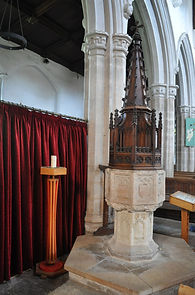
Just a few things to add; the font dates from the font dates from the 15th century with octagonal bowl and stem, with the bowl decorated with blank shields. There is a piscina set in to the south wall at the east end of the south aisle, indicating that the Mass was given out at a side altar. Finally, it is thought that the stalls in the chancel came from Ramsey Abbey following the dissolution of the monasteries. There are some wooden carvings here of great quality which includes the pelican in its piety. This is a carving of a pelican who rips at her chest; feeding her chicks with its blood. This was used as an analogy for Christ shedding his blood for us.

To be fair, there is nothing of any great rarity or interest in the church grounds and nothing in the grounds has its own Grade II Listing.
It was time to hit the road; making the short distance to the south west to neighbouring Swavesey. The church here is open to visitors and is well worth taking a look at if you are in the area. There is nothing of any huge significance here; and to be fair the church here doesn't make it in to Simon Jenkins' list of England's 1000 best churches. To me though, this is a beautiful church and one that I wanted to include on this site. There are also a decent number of open churches close by in all directions in what is an open and welcoming area in general for the interested churchcrawler.