SALLE : CHURCH OF ST PETER & ST PAUL
Church Post Code NR10 4SD
Open to visitors
Visited June 2022
I first visited Salle in February of 2018. The ‘Beast from the East’ had met storm Emma and much of the country was blanketed under snow. As a professional gardener I take most of my breaks during the winter and I had hired a holiday cottage in Cromer at that time; this providing an interesting journey with memories of three foot snow drifts at Swaffham where the snow ploughs had been through, still fresh in the memory.
It was a little above freezing with snow still on the ground when I arrived at the church of St Peter & St Paul; three days later and was pleasantly surprised to find it open! All credit to anyone who opened up that morning. Entering in through the north porch the cold hit me; my goodness it was cold inside! This is a truly huge interior and surely impossible to heat in winter!
The revisit was in June 2022; on a day’s churchcrawling in Norfolk which had also seen a visit to neighbouring Booton, the church of St Michael and All Angels, and its gloriously eccentric gothic church and, to be fair, its gloriously eccentric Victorian vicar Whitwell Elwin who designed the rebuilding of this church himself; which included a series of stained glass depictions of the various women that Elwin had apparently been friends with during his life. We had also visited St Agnes at Cawston where I had the great pleasure of spending a little time with a lady who was 106 years old; revisiting her old church from a nursing home, who was sat in a wheelchair as close as possible to the seat that she regularly sat in as a child getting on for a hundred years previously!
It was about 25 degrees warmer than on that original visit as we pulled up at Salle church; warm and pleasant, a typically English village scene with a cricket match going in the cricket ground adjacent to the church.

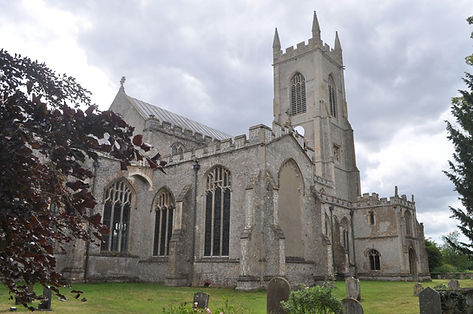

Salle is a hamlet of around 20 houses a few farms and a church. The population was 50 at the time of the 2001 census. It is to be found some ten miles north west of Norwich. The beautiful market town of Aylsham is a few miles off to the east and Cawston, with one of the finest rood screens in East Anglia, is around three miles away in a south easterly direction. Also close by is Reepham, interesting as it has three churches, one being a ruin, in one churchyard.
The church of St Peter & St Paul at Salle was built between 1400 and 1450, likely replacing an earlier church that was previously on this site, and is viewed as one of the finest parish churches in Norfolk, and indeed the whole country. The church is vast, standing proud against the flat Norfolk landscape.
This is a wool church, with the church being built on the vast profits that were made at that time from the wool trade. Merchants in the area at that time compiled vast fortunes and at one point Norwich was England’s second city behind London. These wool churches were not built in accordance with the population of the village, rather they were built as an act of devotion; built to the glory of God but also as a means to pray and sing masses for the donors and their families; lessening the time that they had to spend in Purgatory following their deaths during those pre reformation days when the state religion was Catholic. Several key families were responsible for the church here being built; among them Geoffrey Boleyn, an ancestor of Anne Boleyn, the second wide of Henry VIII.

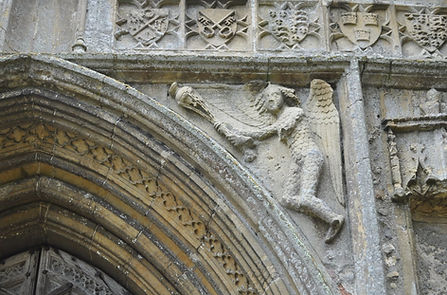


The church consists of west tower, nave with north and south aisles and clerestories, north porch, north and south transepts and chancel. Something quite horrible appears to have happened to the north transept with the large window being bricked up and a large monument being placed in front of it. The wealth of the benefactors of this church at the time of construction was that expensive Barnack stone was shipped in from near to Peterborough for building.
The heavily buttressed west tower, which stands 111 feet tall, is of four stages, with the top stage dating from the early 16th century. A battlemented flushwork parapet surrounds the top with a crocketed pinnacle at each of the four corners of the tower. A clock can be seen on the east face of the tower.
The north and south porches are each of two storeys and there are six two light windows on the north and south clerestories. The south transept has a fine four light south window. The north transept has a three light east window, but as already mentioned the north window is no more; bricked up sadly. The battlemented flushwork parapet extends throughout the nave and transepts.
At the time of L’Estrange’s Victorian study of the church bells of Norfolk, there were six bells hanging here, with two of these being of great age and antiquity. The first two of the ring were from Thomas Mears, each cast in 1836. The third was cast by Charles Newman, a founder from Norwich, in 1698.
The first of real history is the fourth of the ring which is inscribed ‘EDMVNDVS DE LENNE ME FECIT’. The De Lenne refers to Kings Lynn and this is attributed to Edmund Belyetere who worked out of premises in Kings Lynn. The National Church Bell Database dates this bell at c1330 but that does not fit in with known founders of that name, but it is safe to say that this was cast either 14th or early 15th century.
The fifth of the ring in dated 1852 and came courtesy of C&G Mears in 1852. The sixth of the ring at that time is the other of real interest. This was cast by Richard Baxter, a Norwich founder, in 1420. Baxter had a prolific career and was active from 1416 until 1457. Today the situation is different in that there is a ring of eight bells. Two more were added by Mears & Stainbank in 1912.
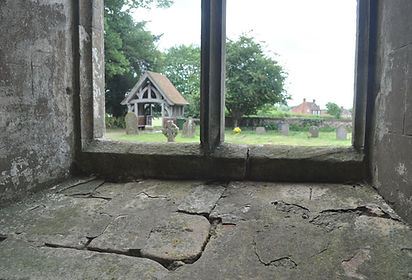


Moving inside, as you would expect there is a real sense of space here at it was good to just stand and take in the interior; trying to imagine what things must have been like here in pre reformation days; with full time clergy at work in the various chapels; the sounds of Masses being said or chanted, the smells of incense; the hustle and bustle of a busy pre reformation church. Things would have altered greatly after the Reformation; with the chapels closed down, rood lofts and the rood themselves taken down and destroyed; stained glass broken and statues defaced as the reformers attempted to strip worship back to its basics and get rid of those things which had been seen to be a staple part of worship; but which were now deemed to be idolatrous.
There are six bay arcades to north and south, with piers consisting of four shafts with four hollows. Walls are whitewashed with several hatchments from the great and the good of the parish. The centre aisle is very wide, with grave slabs running towards the chancel. A glance upwards shows an area above the chancel arch where there is evidence of wall painting; perhaps there would have been a doom painting here at one point illustrating graphically what would happen to those judged as being righteous or otherwise of the day of judgement.


The lower stages of a medieval rood screen separate nave from chancel; the visitor enters in to the chancel through doors on which are 15th century paintings of the Four Doctors of the church, Gregory, Jerome, Augustine and Ambrose. Some panels are blank but two panels to the left of the door have depictions of Thomas and James; to the right are Philip and Bartholomew. Up in the spandrels we see St George in battle with the dragon along with animals including an eagle, lion and pelican. The magnificent east window of the chancel is of seven lights with a little stained glass in the tracery.


Some superbly crafted wooden carvings can be seen in the choirstalls with carvings on the benches and also the misericords. Some figures are damaged, with some having been repaired. We see a bird feeding its chicks, and a squirrel eating a blackberry. Close by we have a bird asleep; its long neck laying relaxed at its side. Still continuing the theme of animals we also see a crouching monkey. There are some human characters which include a stern faced bearded man, two monks staring intently at each other from adjoining stalls and a beautiful depiction of a nun, eyes modestly downturned; features worn away a little through centuries of touching.


In the misericords are also an eclectic lot. Included in their ranks is a pair of leaping fish, the two creating a mirror image. Close by we see a grotesque smiling lion with wild hair and teeth which could possibly with being looked at. A male figure with curly hair and beard appears to be asleep; one further male figure smiles at the onlooker, with hat on at a jaunty angle. A female figure wearing a headdress looks out serenely; one other male figure looks to be laughing; perhaps this is a jester!


There are lots of medieval stained glass fragments to be seen here; as always it is interesting to think what it must have looked like before much of it was destroyed. Angels playing musical instruments can be seen alongside robed figures whose heads have been replaced with clear glass. One of the donors of the church is depicted, kneeling, his oversized hands symbolising piety. Mary sits on a throne, dressed in blue robe, crowned as the Queen of heaven.
For me though, the most interesting panel is an angel, who curiously looks to one side rather than looks the onlooker in the face, who is holding a Trinity Shield, a diagram which consists of three nodes, which denote Father (Pater), Son (Filius) and Holy Spirit (Spiritus Sanctus). These are connected by six links which go to describe the concept of the Holy Trinity to the onlooker. We can read from this that "The Father is God" "The Son is God" "The Holy Spirit is God" "God is the Father" "God is the Son" "God is the Holy Spirit" "The Father is not the Son" "The Father is not the Holy Spirit" "The Son is not the Father" "The Son is not the Holy Spirit" "The Holy Spirit is not the Father" "The Holy Spirit is not the Son".


The font here also dates from the mid 15th century and is a seven sacrament font. This details the seven sacraments of the Catholic Church, with the eighth panel of the octagonal font containing a depiction of the crucifixion. The first three sacraments are the sacraments of Initiation, namely Baptism, Confirmation and Eucharist. The belief is that the person is born anew by Baptism, strengthened by Confirmation and nourished by the Eucharist.
The next two sacraments are sacraments of healing. The first of these is Confession (penance and reconciliation) and the second is the anointing of the sick, where the priest anoints the afflicted with Holy Oil. When this is administered to those who are dying it is called Extreme Unction.
The final two sacraments are Holy Orders, which is the Sacrament by which a man is made a bishop, a priest, or a deacon, and thus dedicated to be an image of Christ. The final sacrament is marriage. This is an impressive and historic piece of work, which still shows some traces of damage inflicted during the reformation.


The Crucifixion

Baptism

Confirmation

Eucharist

Extreme Unction

Holy Orders

Confession

Marriage
A few other things to note here; there are some excellent ceiling bosses which I certainly haven’t done justice to, but are probably just decent enough to post up. These cover the nativity, Jesus being presented to Simeon in the Temple, the Triumphal entry, the Last Supper, the Crucifixion and the resurrection.
There is some modern glass which I have not touched upon. One window looks at the history of the church here at Salle making note of the donors. Another is a Tree of Jesse window which denotes the lineage of Jesus from Jesse central at the bottom through to the Virgin and child at the top.
There is also an interesting three light window showing three saints. From left to right we have St Helen, who is accredited with finding the ‘true cross’ in Jerusalem. She was the mother of Constantine the Great and a pivotal figure in the spread of Christianity. Central we have St Nicholas who is shown carrying a bag of money. Legend states that he gifted a bag of gold to a man to save them from poverty and to keep the daughters out of slavery. This led to the tradition of St Nicholas leaving gifts at Christmas. To the right we see St Catherine, shown with spiked wheel, on which she was scheduled to be martyred and a sword pointed down, which was her manner of death; being beheaded after the spiked wheel shattered. She holds aloft a palm, signifying that she is one of the Virgin Martyrs.
Looking at both transepts; as mentioned earlier there has been a window taken out of the north wall of the north transept, with two monuments in its space. These are to Edward Hase, who had Salle House built in 1763. Hase died in 1804 at the age of 71 years. Below is a memorial to his wife Virtue who passed away in 1801 in her 69th year. Apparently the loss of the window did not go down well at all and resulted in a lawsuit brought by the rector in protest.
Evidently, not surprisingly, the removal of the window caused a few raised eyebrows at the time. The south transept is a bright, welcoming space with, with the exception of a few medieval glass fragments in the tracery, clear glass on three sides.


A fine church; open and welcoming to visitors and an absolute must visit for those in the area. If you are around and want to make a day of it then Cawston and Booton are each close by and the delightful market town of Aylsham and its magnificent church is roughly seven miles away to the east. The majority of churches will be found open in this most welcoming of areas. We made our way back to the car; there was some excitement at the cricket with a dignified round of applause, a batsman (or batter as we are now instructed to call them) raised his bat in acknowledgement; I suspect passing 50 or a ton!