WHISSENDINE : CHURCH OF ST ANDREW
Church Post Code LE15 7HG
Open to visitors
Re-visited April 2025
Whissendine is a relatively large village on the Rutland/Leicestershire border, which recorded a population of 1,245 at the time of the 2021 census. At the time of the previous census in 2011 Whissendine was the sixth largest settlement in Rutland.
Fond memories of the old and much missed number 9 bus route which was run by Kimes and then by Centrebus; which sadly is no more. This route ran from Peterborough to Nottingham, running through Whissendine and past the church, before heading off to Melton Mowbray a few miles off to the North West.
Whissendine can be found mid way between Oakham and Melton Mowbray; the Leicestershire border to be found close by to the north and west of the parish. There was no mention of a church or priest here at the time of the Domesday Survey in 1087, with land at that time being owned by Countess Judith, who was niece of William the Conqueror.


I have made a number of visits to the church here; with the last one in late April of 2025. A previous trip here with David late on a glorious Sunday evening in August 2015 was shot in some of the most beautiful lighting conditions and with delicate cloud formations.
The church here is considered to be one of the finest in Rutland, and is a real statement piece, with the 100 foot perpendicular tower dominating the local landscape. It is said that there has been a church here since the 12th century, but nothing of that original structure remains. The nave, chancel, aisles and north transept all date from the 13th century. The tower was completed in the 14th century along with the south porch being added and the church being extended. The clerestory was added in the 15th century and there was Victorian restoration here in 1870 under George Gilbert Scott.
The church that we see today consists of west tower, nave with north and south aisles and clerestories, South porch, north and south transepts and chancel.
Built of Barnack stone in the 14th century, the tower is a three stage affair, pinnacled at each of the four corners. Tall and elegant lancet windows are to be found on each side of the third stage. Empty niches would once have contained statues in pre reformation days and the church clock is of the traditional blue and gold; as per an original decree issue by King Henry VIII. A door and window in the bottom stage of the west end of the tower are enclosed by a three tier archway.
Gargoyles, a bit battered and weathered, are dotted around the top of the tower; these including what appear to be a bear, a creature with wings tightly furled against its side and a happy looking human figure which has both hands cupped against its ears which might be a message against gossiping to those looking upwards.


A corbel string runs across the top of the tower frieze consisting of grotesque heads; with many contorted and grimacing; others look out in a disapproving manner.
The clerestory takes the form of six three light windows with intricate tracery; the nave and clerestory are each battlemented with corbel strings, again with a succession of grotesque heads, running the full length of each.
At the time of North's Victorian study of the church bells of Rutland there were four bells hanging here. Two of these date from 1609 and were cast by Henry Oldfield II from his foundry at Nottingham. One of these bells is inscribed 'God Save His Church'. The other states 'My Roaringe Sounde Doth Warning Give That Men Cannot Heare Always Lyve'.
Edward Arnold of Leicester cast one here in 1785 and at the time of North's study, the other bell had not long been re-cast by Taylor of Loughborough. Accounts survive from 1872, when this bell was re-cast, and Taylor's invoice came to £72 7s 2d.
Two bells have been added since that time, giving a ring of six today. One was added by Warner and Sons of Cripplegate, London in 1897, which may have been added for Queen Victoria’s Diamond Jubilee and a further one by Taylors in 1906.


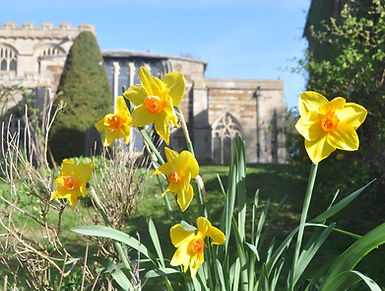
On my visits here over the years I have only once found the church closed; the visitor enters in through the south porch, the path leading to the porch lined with daffodils. The ‘Church Open’ sign was out and we were good to go.
There isn’t too much in the way of stained glass here and this, combined with the large amount of clear glass to the south, made for a bright and welcoming interior.
Inside we have a church of impressive dimensions; there are five bay arcades to north and south which each date from the 13th century, with elaborate quatrefoil piers. The faint outline of the previous roof line can be seen over the chancel arch and more distinctly against the west wall of the nave; this indicating the roofline before the walls were heightened and the clerestory windows added to allow in more light.


Moving in to the chancel; this was almost derelict at the time of the restoration of 1870. The remodelled chancel has oak panelling along three sides; with this having taken out some of the history with the panelling covering over where the sedilia and piscina would have been against the south wall.
The stained glass in the five light east window is from the Kempe Studio but after the death of Charles Eamer Kempe. His mark was a wheatsheaf and after his death in 1907 the business was taken over by his cousin Walter Tower. The traditional wheatsheaf was continued with a black tower on top of it. This is what we see here on this glass, the signature appearing in the tracery to the north of the design.
This glass dates from 1910 and features scenes from Holy Week on the upper level; with three panels depicting the crucifixion flanked by Jesus at prayer in the Garden of Gethsemane and the deposition when Jesus was taken down from the cross.
Lower down we see The Virgin and child central; flanked by a two light depiction of the nativity with the wise men presenting their gifts and Jesus being presented to Simeon in the Temple; with Anna watching on in interest.
Up in the tracery we see the four Gospel writers; the four doctors of the Latin church, namely St Ambrose, St Augustine of Hippo, St Jerome and Pope Gregory the Great. Close by. Two angels carry symbolically blood red shield on which are symbols of Christ’s passion. On one we see nails and the crown of thorns; the other has a hammer and pliers.
The reredos is also from the Kempe studio and features six main gilded characters which include St Andrew, after who this church is dedicated, who is depicted as usual carrying the saltire cross. We also see St Peter who carries the keys to the Kingdom of Heaven. Among the others we can also see St Edmund, the King of East Anglia who carries an arrow; which denotes the manner of his martyrdom at the hands of the Vikings in 869AD. In between these characters we see a celestial orchestra or angel musicians.


The church here is well known for its fine tie beam nave roof and its clerestory figures. The supports end in an ancient figure, with each one seated under an ogee headed canopy. At the foot of each figure is a crouching figure which does appear to have the age of the figures above them. There are 12 in total; perhaps we have here a medieval representation of the 12 tribes of Israel. That is purely a guess based on the numbers; it doesn’t appear to be the disciples certainly which would be another guess based on numbers.
The seated figures are bearded with some appearing to wear mitres. They look out across the nave sternly. The crouching figures below are carved from wood with great skill. Some play musical instruments, one holds a jug and a bowl, woodworm holes visible on the carving when seen up close through the zoom.
One other figure, which does not have a seated character above it, has its hands cupped to ears in the same way as the character on the tower. One beautifully carved figure is at prayer, another appears to be asleep. A fascinating collection with the more ancient seated carvings being a rare survival as they would have been a target for the reformers; being destroyed as being idolatrous.


Just a few other observations here; there is an oak screen which runs across the east end of the south aisle, turning the south transept in to a lady chapel. This screen was added as part of the restoration of 1870 but the screen itself is far older; dating from the 15th century and being brought in from the Chapel of St John’s college, Cambridge.
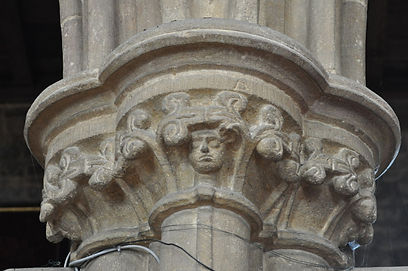
If you feel that you are being watched when in the nave, that might be due to the number of grotesque faces looking out across the nave; including one for a male figure who appears to be having a meltdown. There are also faces peering out from the capitals in the north arcade.
A single stone to the west of the nave caught my eye; this simply having the word ‘John’ carved in to it. Possibly a simple memorial to a friend or family member long since passed on.


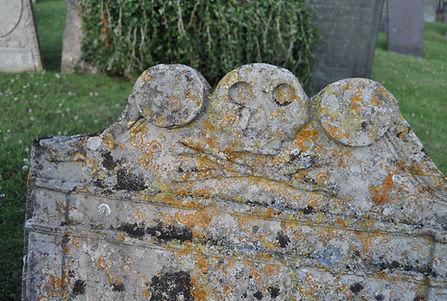
The church grounds are of great interest. Some superbly crafted stones dating back to the eighteenth century, with some in slate, as one would expect from this part of the country. A crudely carved human skull with crossed bones underneath, reminds the onlooker that Man is mortal and will die. Close by a very weathered angel is in flight carrying a crown; this is the crown of victory with the victory here being over death. Close to the tower a simple grave with a simple inscription 'I P 1721'. A finely carved slate grave depicts a human figure carrying an anchor. The anchor was often used as a symbol of Christian faith and symbolises here the faith of the deceased. A closer look reveals text which reads 'Life how short eternity how long'. An angel is close by, symbolising the safe escorting of the soul to Heaven whilst death in the form of a skull peers from around a curtain.

And to complete this look at the church of St Andrew at Whissendine; a few photographs from the Sunday visit back in 2015 mentioned at the start of this page. A wonderful church in the most beautiful lighting with a glorious sky.


The church here is the absolute jewel in the crown of a beautiful county. Open and welcoming with a great deal for the interested visitor to see! For those wishing to make a day of it; there are normally plenty of other open churches within a few miles in any direction. The church of St Andrew is a must visit if you are in the area. This is my favourite church in Rutland and I think would come in to my top ten churches visited.